
Introduction
“Your teeth look a little darker.”
Sometimes it takes another person saying it before you notice. You check an older photo. Then a recent one, and it turns out they are right.
But where did the change come from?
Maybe years of morning coffee have gradually left their mark. Perhaps the teeth have become more yellow with age. One tooth may look noticeably darker than the rest. Or the shade difference you keep seeing could involve a crown that has not changed while the surrounding natural teeth have.
From the mirror, these situations can all look like the same problem:
Discoloration.
They are not necessarily the same.
That distinction matters because whitening works best when the treatment addresses the actual cause of the concern. A patient with generalized yellowing may have a very different starting point from someone with one dark tooth after an old injury. Existing veneers, crowns, and fillings can change the conversation again because they generally do not respond to whitening like natural teeth.
For patients researching teeth whitening in Charlotte, NC, the first decision is not always between in-office and take-home treatment.
Sometimes the better first question is:
What exactly am I trying to whiten?
In this guide, we will explore;
- Why all tooth discoloration is not the same
- Common professional whitening options
- How in-office and take-home approaches differ
- Benefits of dentist-supervised whitening
- Common questions patients ask before treatment
Before Choosing a Whitening Option, Understand What Changed the Color
People use the word “stained” very broadly.
A tooth looks darker? Stained.
Does the smile appear more yellow than it did ten years ago? Stained.
One front tooth no longer matches its neighbor? Also stained.
This language is convenient, but it can hide meaningful differences.
A dentist evaluating someone interested in professional whitening in Charlotte, NC, may look at the pattern of discoloration before discussing how to brighten the smile.
Their appearance can change with age because tooth color is influenced by more than the outer surface. Enamel is translucent, and the underlying dentin contributes to what we see.
Therefore, professional whitening should be approached based on your unique condition, not just as a treatment.
How Does Professional Teeth Whitening Work?
1. Smile Evaluation
The dentist checks the teeth and gums and then gives advice on treatment. This helps identify oral health concerns, visible restorations, unusual discoloration patterns, and other factors that may influence whitening.
2. The Discoloration Review
The dentist will determine whether the problem is generalized yellowing, external staining, localized darkening, or some other pattern. This step helps to shape realistic expectations.
3. Exploring Whitening Options
Following the review, it’s time to consider treatment options. The recommendation may be influenced by the patient’s schedule, preferences, sensitivity history, cosmetic goals, and clinical findings.
4. Whitening Procedure
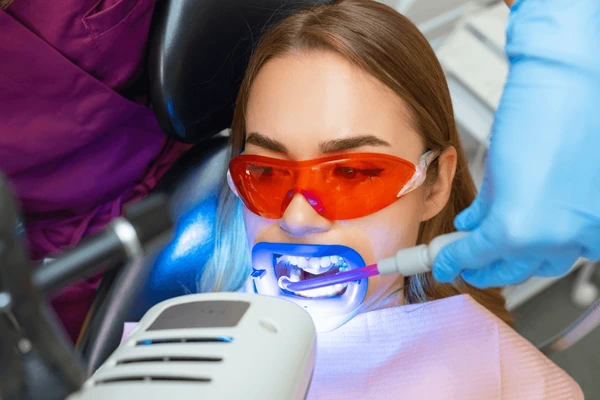
After the option is locked, treatment is carried out as chosen. It can be an in-office treatment or a take-home regimen supervised by a professional.
5. Result and Maintenance Review
The patient can discuss the outcome and receive guidance on maintaining the appearance’s brightness. Habits, oral hygiene, regular dental care, and future touch-ups may all play a role.
At A Glance
| Who Qualifies? | Adults who are not satisfied with their smile and want to improve it by a few shades are ideal candidates for the treatment. |
| Process Overview | Step 1
The procedure starts with an initial visit to your dentist for teeth whitening. Step 2 Following the examination, it’s time to apply a whitening gel and allow it to settle. Step 3 Once settled, your dentist will apply UV rays to whiten it considerably. |
| Timeline | Teeth whitening is a quick treatment and doesn’t require more than one visit to your dentist. |
| Aftercare | Follow your dentist’s aftercare tips to ensure longevity of the white smile. |
| Location & Contact | Smile Charlotte
2711 Randolph Rd Ste 205, Charlotte, NC 28207, United States |
Benefits of Professional Teeth Whitening
Begins With Understanding the Current Smile
Whitening professionally is more than just applying a product. First, the dentist examines the teeth, gums, existing restorations, and the pattern of discoloration. Why does this matter? Because generalized yellowing, one dark tooth, or a crown surrounded by natural teeth may each require a different pre-treatment discussion.
Offers More Than One Way to Approach
Some patients prefer to have the treatment completed in the dental office. Others like the flexibility of a professionally monitored take-home option. If several approaches are available, the whitening plan can incorporate practical preferences and clinical findings, rather than assuming that a single process is ideal for each patient.
Provides direction on existing dental work
Crowns, veneers, and fillings tend to remain the same shade and can affect whitening expectations. A professional can assess the location of these restorations and determine whether brightening the surrounding natural teeth could make the smile look more noticeable.
Eliminates Guesswork About Using the Product
You can see whitening products on store shelves: strips, gels, pens, pastes, and others, with a variety of instructions. The chosen system will provide a defined approach and professional treatment. Patients are being advised on how to use the treatment rather than switching products every other day if they are not seeing the results they want.
Can I Whiten Teeth Without Reshaping Them
Some patients are comfortable with the size and position of their teeth but find the smile has become dull. Whitening is about the color of your teeth, not their shape or alignment. It may be a simple cosmetic option for suitable candidates when discoloration is the primary concern.
Leads to More Realistic Expectations
Not all smiles will come out the same shade, and not all stains will react the same way. Professional guidance can help patients to understand what might be possible for them from their starting point.
Professional Teeth Whitening at Smile Charlotte
Patients interested in whitening can arrive with concerns that sound similar but look very different during an examination.
At Smile Charlotte, a whitening evaluation considers the condition of the teeth and gums, visible restorations, sensitivity concerns, discoloration patterns, and the patient’s cosmetic goals before discussing available options.
For patients researching Smile Charlotte whitening or looking for professional whitening in Charlotte, NC, this assessment provides context before treatment begins. Book a visit today!
FAQs
- How long does professional teeth whitening last in Charlotte, NC?
You can expect professional whitening to last on your teeth for a few months to a few years, depending on your teeth and habits. Discoloration can return faster or slower depending on coffee, tea, tobacco, pigmented foods, oral hygiene, and natural aging. Different patients have different maintenance needs.
- Is in-office teeth whitening in Charlotte better than take-home?
One is not always better than the other. In-office whitening may be desirable for patients who want treatment at the dental practice, while supervised take-home whitening offers greater flexibility and a more gradual progression. The best fit depends on your teeth, goals, schedule, and available treatment options.
- What is the cost of teeth whitening in Charlotte, NC?
Teeth whitening costs in Charlotte, NC depend on the whitening method, dental practice, and specific treatment plan. Fees for in-office and professionally supervised take-home options may differ. A consultation gives a more accurate estimate based on the suggested method.
- Is professional whitening able to remove every type of stain?
No. The results of whitening depend on the cause and nature of the discoloration. Some yellowing may be more responsive than some internal color changes. A single dark tooth can also need further investigation. Crowns, veneers, and fillings may not whiten as natural teeth do.
- Is tooth whitening safe for sensitive teeth?
Some patients with sensitive teeth may be candidates for professional whitening, but an individual evaluation is important. A dentist can review the sensitivity history, examine the teeth, and discuss appropriate options. Some patients may feel temporary sensitivity during or after treatment.
Conclusion
Two people can both say their teeth look stained and mean completely different things.
One may notice years of gradual yellowing, while another may have discoloration linked to everyday coffee or tea habits.
That is why choosing a whitening option should not begin with the assumption that every color change is the same.
In-office whitening may suit some patients. The best whitening dentist in Charlotte, NC, may offer supervised take-home treatment that may fit others. But before selecting either approach, it helps to understand what has changed in the smile and whether the discoloration is likely to respond as expected.
If you are considering teeth whitening in Charlotte, NC, a dental evaluation can provide that context. Book a call with our experts at Smile Charlotte today!